Out-of-home advertising, from fixed screens to moving ones
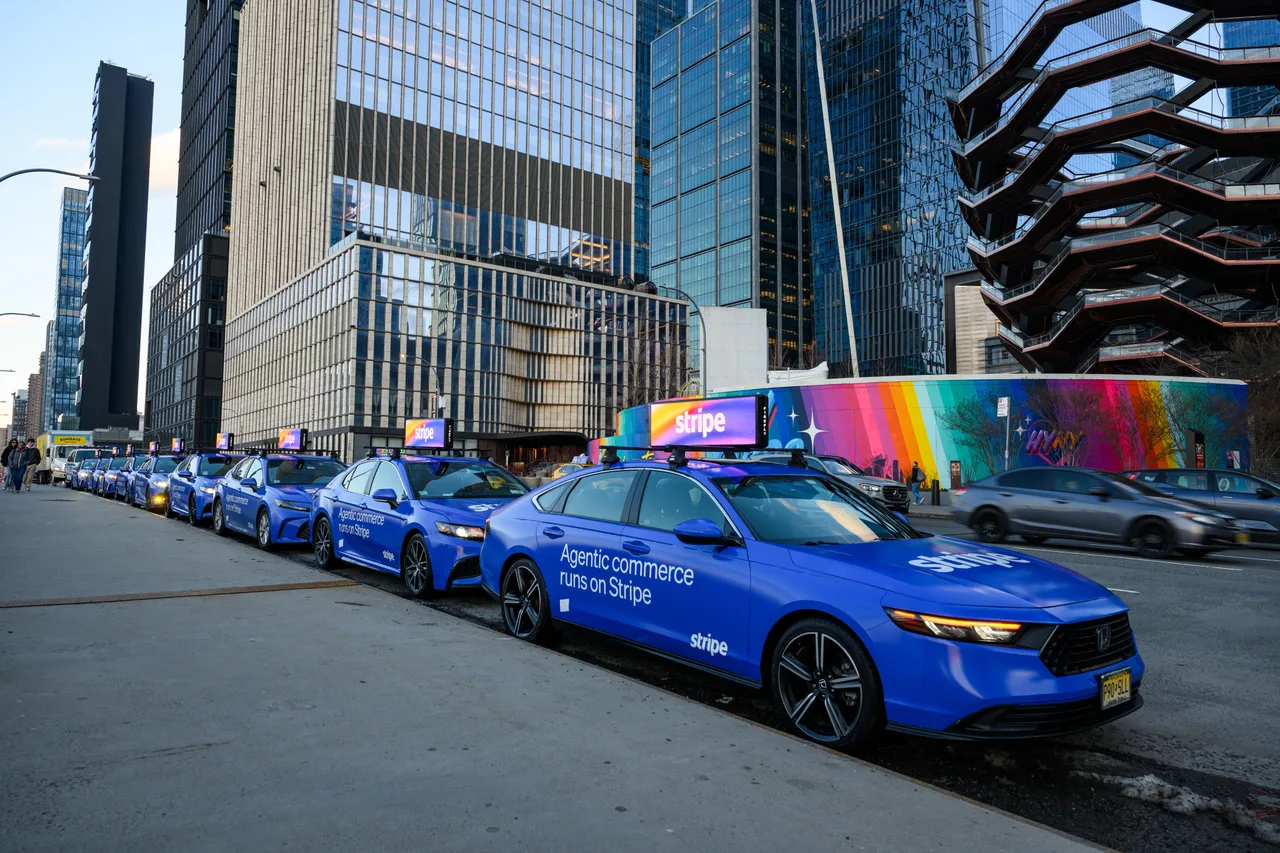
Out-of-home advertising is any advertising seen outside the home, from printed billboards to screens on vehicles. US OOH revenue reached $9.46 billion in 2025 according to OAAA, with digital formats at 36.3% of the total. Most explainers assume the screen stands still. This one covers what changes when it moves.
This guide covers the category as a whole: what the formats are, how they are bought, how audiences are counted. It differs from the other explainers on the subject in one respect. It does not assume the ad surface is bolted to something. Every published introduction to out-of-home files vehicle-mounted inventory under "specialty" or leaves it out, and then applies fixed-panel logic to the whole market.
What is out-of-home advertising?
Out-of-home advertising, usually shortened to OOH, is advertising that reaches people while they are outside their homes. Billboards, bus sides, subway platforms, mall screens, stadium boards, vehicle wraps and truck displays all sit inside the definition. The common thread is not the format but the setting: the audience is out in public, moving, and not choosing to look.
That last part matters more than it sounds. Nobody scrolls to an out-of-home ad, and nobody can be retargeted into looking at one twice on purpose. The medium is bought on presence rather than attention capture, which is why its measurement question (how many people had a reasonable chance to see this) looks nothing like the click-based questions asked of digital media.
How big is the out-of-home market?
US out-of-home advertising revenue reached $9.46 billion in 2025, up 3.6% on 2024, according to the Out of Home Advertising Association of America. That extended the industry's run to nineteen consecutive quarters of growth.
Two lines inside that total are worth separating. Digital out-of-home was 36.3% of revenue and grew 10.5%, close to three times the pace of the category. And transit was the fastest-growing segment for the second year running, at +9.8% in OAAA's Facts and Figures deck (slide 4). The association's press release for the same year prints 9.2% for transit, and neither document explains the difference. Applied to the 2024 category dollars, 9.8% is the one that adds up to $9.46 billion, so that is the figure used here.
One more caveat OAAA prints on its own slides: it estimates that the spend-tracking source behind its category charts under-reports OOH by roughly 30%, and says those charts are best used for direction over time rather than absolute size. Take the growth rates seriously and the dollar split loosely.
What are the main out-of-home formats?
The industry's traditional answer is four buckets: billboards, transit, street furniture and place-based. It is a workable list for fixed sites and a poor one for everything else, because it sorts inventory by where it is installed, which stops being a useful question the moment the inventory drives away.
A more honest split separates three things the standard vocabulary jams together: what the ad surface is, what carries it, and how those carriers are deployed. Sorted that way, the list stops hiding everything mobile.
Ad surface: what the advertising physically is
| Surface | What it is | Changes mid-flight? |
|---|---|---|
| Digital screen | An emissive display running a loop of advertisers | Yes: creative and schedule |
| Static print | Printed vinyl or paper, installed once | No: reprint and reinstall |
| Vehicle wrap | Printed film applied to the body of a vehicle | No: the wrap is the campaign |
| Hologram / projection | Projected imagery, used where a flat panel gets ignored | Yes |
| Spectacular | Oversized landmark placement, built for the site | Depends on the build |
Carrier: what the surface travels on
| Carrier | Who it reaches | Who sets the route |
|---|---|---|
| Fixed structure | Whoever passes one location | Nobody. It does not move |
| Car or taxi top | Street-level traffic and pedestrians along a route | The operator, or you |
| LED truck | Dense pedestrian areas, events, chosen corridors | You |
| Transit vehicle | Riders and everyone on the service route | The transit authority |
| In-car screen | The passenger, for the length of the ride | Irrelevant. It is a dwell format |
| Pedicab | Pedestrians, at walking pace | The operator |
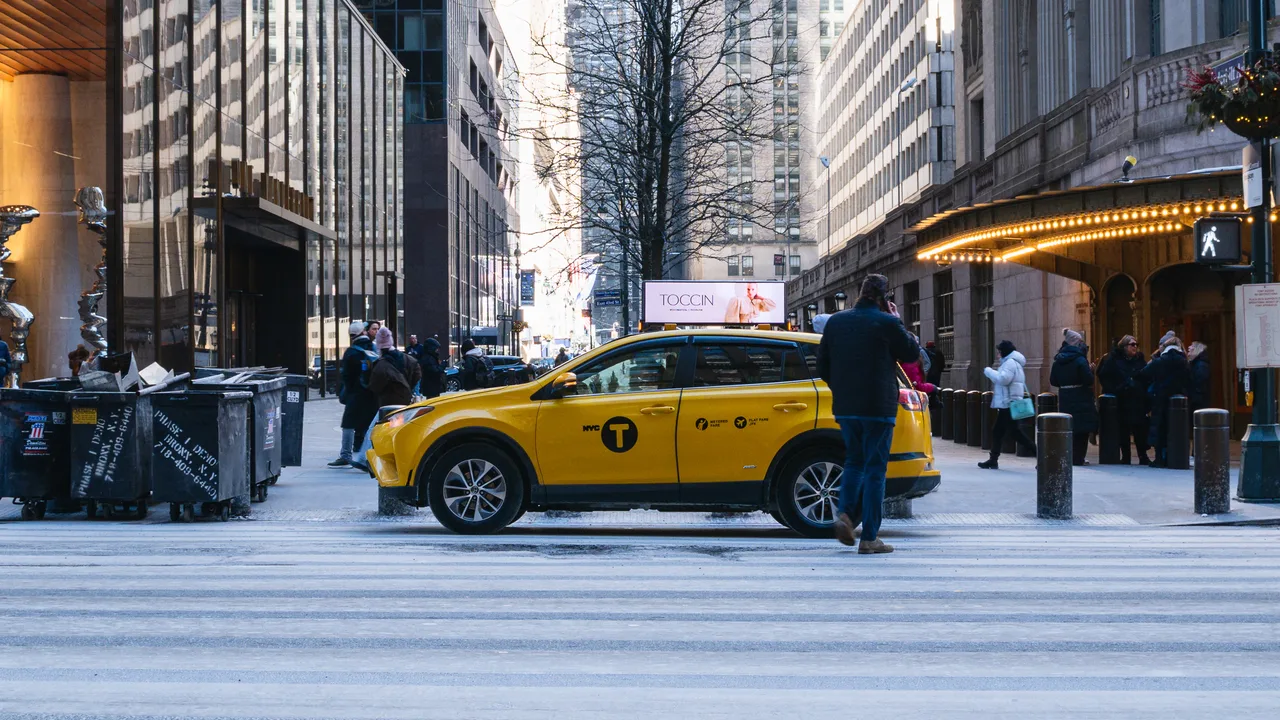
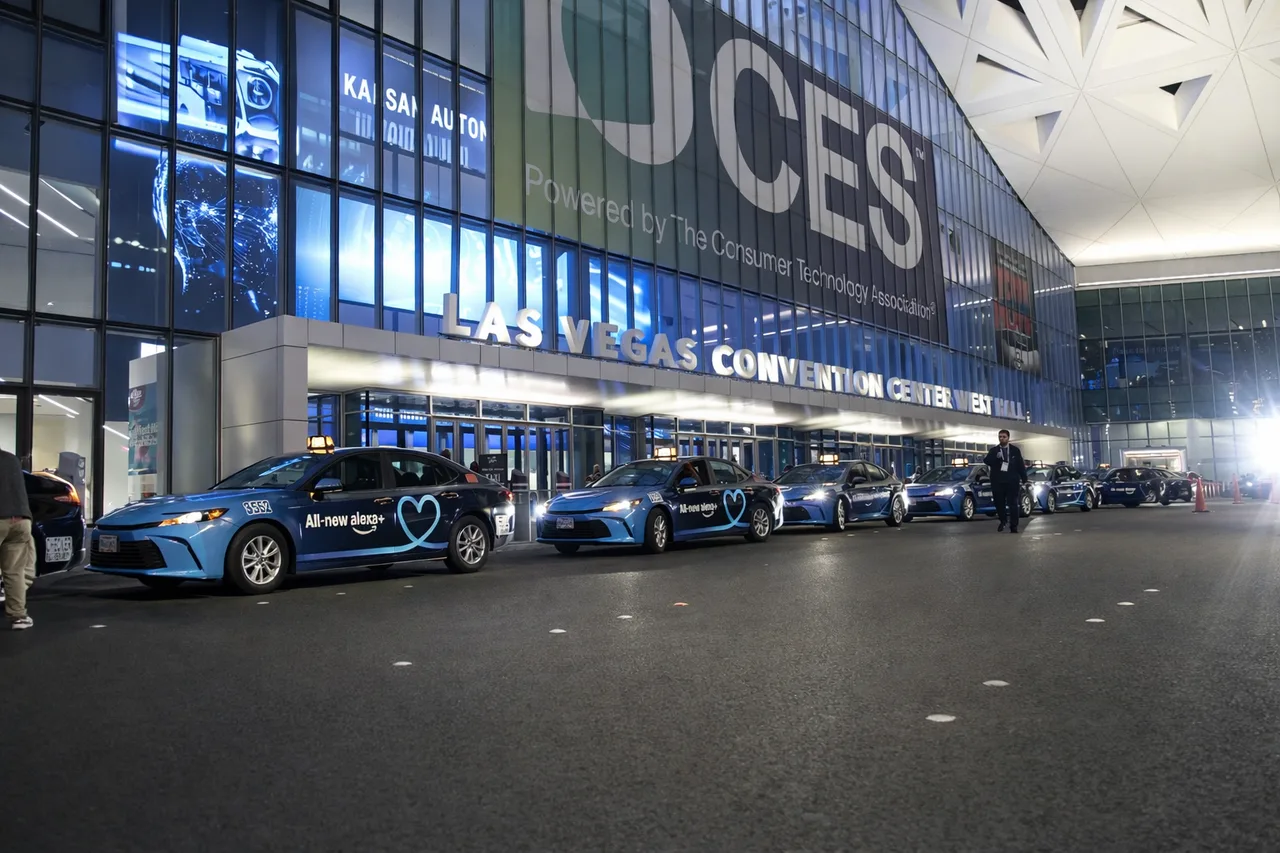
A third facet, deployment, describes how many carriers work together and how they are routed. A single truck parked at a venue is a different media buy from forty wrapped cars circulating a downtown grid, even when the surface and the carrier are identical. The two frames below are the same category and two different products: one taxi top in Manhattan traffic, and a fleet of wrapped cars lined up at a Las Vegas venue for the length of a trade show.
What changes when the screen moves?
Everything downstream of "where is it." A fixed panel occupies one coordinate for the length of the campaign. A vehicle-mounted screen occupies a route, and the route is a variable you can set.
| Fixed screen | Moving screen | |
|---|---|---|
| What is counted | Audience passing the screen | Screen passing the audience |
| Primary input | Traffic volume at one point, adjusted for visibility | Route, dwell time in a zone, speed, time of day |
| Geography | Fixed for the length of the flight | Can change within the flight |
| Frequency | Commuters on the same route see it repeatedly | Repetition is managed by rotating routes |
| Dayparting | Creative changes; the site does not | The inventory itself relocates by daypart |
This is the part most category explainers get wrong by omission. They describe DOOH as "digital billboards" and then apply fixed-panel logic to every screen in the market, including the ones on wheels. The measurement chain, and exactly which of its inputs stop working on a vehicle, is worked through on how out-of-home impressions are measured. The planning consequence, that geography becomes something you choose rather than inherit, is the subject of location-based advertising.
Who sells the moving column, in each seller's own words: Firefly sells digital and static tops on taxis and rideshare vehicles, 360, 270 and 180 wraps, LED trucks and in-car TaxiTV, and names 15 markets for the tops. Carvertise sells wraps on rideshare and delivery drivers' cars. Can't Miss US runs LED trucks nationally. None of the three is a billboard owner, which is why the format is absent from the rate cards of the companies at the top of every ranked list.
How is out-of-home actually bought?
Three buying units cover almost everything in the market, and confusing them is how budgets get compared incorrectly.
Posting period
The traditional unit for printed inventory. You buy a specific site for a block of time, commonly four weeks, and your poster is the only thing on it for the whole block. Production and installation have to be scheduled, so decisions get locked weeks before anything appears. What you are buying is exclusive occupancy of a physical space.
Share of loop
The standard unit for digital screens. A screen runs a loop of several ads, and you buy a slot in that loop across a set of screens for a set period. If the loop holds eight spots and you have one, your ad is on screen an eighth of the time. Nothing is printed, so creative can be changed mid-flight and different creative can run at different hours on the same screen. What the screen adds and what it does not fix is covered on what is DOOH; the loop arithmetic, operator specs and dwell rules for the roadside version are on digital billboard advertising.
Programmatic impressions
The newest unit, and the one that behaves most like the rest of digital media. Instead of buying named sites, you buy delivery against an audience through a demand-side platform, and the system decides which screens serve it. It brings audience targeting and mid-flight optimisation, and it costs you the certainty of knowing exactly which locations your brand appeared on. The supply chain behind that trade is laid out on programmatic DOOH.
Mobile inventory can be sold under any of the three, which is precisely where planners get tripped up. A four-week booking on a wrapped fleet looks like a posting period on the invoice, but the thing you bought is a set of routes, not a set of coordinates. Same paperwork, different product.
How are out-of-home audiences counted?
Out-of-home does not count clicks, so it counts opportunity. The industry measurement body in the US is Geopath, whose glossary separates two numbers that get quoted interchangeably. Circulation is a count of traffic past a location, which Geopath says "only estimates the number of people with an opportunity to see" a display and "is no longer a credible measure of an Out of Home audience." Impressions are the number of times people passing a display "are likely to notice the ad." The step between them is a visibility adjustment derived from the size, roadside position, distance, road type and lighting of the unit.
Four of those five inputs describe a location. Mobile inventory does not have one, so the chain does not fit it cleanly. That is a methodology problem rather than a marketing one, and pretending otherwise is how buyers end up comparing two numbers built from different questions. The framework is also about to change: Geopath and OAAA selected Ipsos in March 2026 for a pilot of a next-generation measurement system launching in the second half of 2026.
Delivery and effect are different questions. An impression count says how many people could have noticed. Whether they remembered the brand afterwards is a separate study, with its own method and its own failure modes, covered on the page about brand-lift studies.
Who do you actually buy from?
Six different kinds of company will all answer the phone when you say you want to run out-of-home, and they sell genuinely different things: media owners with their own structures, transit and street-furniture concession holders, programmatic platforms on the supply and demand sides, managed-service agencies that plan across everything, specialists who run one moving format, and measurement providers who own the audience data and no media. Picking the wrong layer is the most common and most expensive planning mistake in this category.
The role map, the money flow, a comparison table with named examples for each type, and a decision list for which layer to call are on outdoor advertising companies. The digital half of that market, 24 operators and platforms ordered by what each owns and how it is measured, is on DOOH companies.
Which formats move, and who regulates them?
Bus and rail exteriors, station panels, taxi and for-hire tops, wrapped fleets, LED and mobile billboard trucks. They are usually filed together as transit, and they answer to different authorities: the transit agency's own advertising policy for bus and rail, the city's for-hire vehicle licensing body for taxi tops, federal and state vehicle rules for commercial fleets, and municipal traffic ordinances for advertising trucks. In New York a truck operated for the purpose of commercial advertising cannot legally stand or park on the street at all.
The format-by-regulator table, with the rule text for each row, is on transit advertising. The rail half of the category, who holds each system's concession and what each authority refuses to run, is on subway advertising.
Where has each format actually run?
Out-of-home has a proof problem. Almost every vendor page in the category illustrates itself with renders: a mockup of a billboard, a car wrap composited onto a photograph of an empty street. Renders show what a format could look like under ideal light with nobody in the way.
The archive behind this site takes the other approach: 3,783 photographs of campaigns that ran, covering 603 brands across 21 US markets between 2020 and 2026. The table below is derived from it. Each cell is the number of documented frames of that ad surface in that market, for the eight most-documented markets.
| Market | Digital screen | Vehicle wrap | Static print | Hologram | Spectacular | LED truck |
|---|---|---|---|---|---|---|
| New York | 546 | 297 | 212 | 38 | · | 24 |
| San Francisco | 218 | 169 | · | · | · | 22 |
| Las Vegas | 174 | 107 | 9 | 19 | 17 | 34 |
| Los Angeles | 130 | 68 | 4 | 8 | · | 25 |
| Chicago | 113 | 55 | · | 10 | · | 30 |
| Austin | 112 | 65 | · | 20 | · | 9 |
| Miami | 77 | 64 | 3 | 12 | · | 2 |
| Boston | 53 | 36 | · | · | · | 20 |
Reflects campaigns documented in this archive; absence is not evidence of unavailability. Counts are photographs, not campaigns or units, and a frame tagged with two surfaces is counted under each. Of the 3,783 frames, 459 carry a source date that does not parse and are published without a year rather than with a guessed one.
The full matrix, all 21 markets, is on the campaign archive, which can be filtered by surface, carrier, market and year. Eight of those placements are walked through one format at a time on out-of-home advertising examples.
Seven of the rows above have a market desk of their own, each written from the sellers' own pages, the transit authority's advertising standards and the third-party rate publishers, all read live and dated: Chicago, Los Angeles, San Francisco, Miami, Houston, Atlanta and Austin.
What makes out-of-home creative work?
Reading conditions, mostly. The viewer is walking, driving or waiting, the surface is at a distance, and the exposure lasts seconds. Every craft rule in the medium follows from that: few words, high contrast, one idea, a brand mark that survives being glanced at rather than read.
Moving surfaces tighten the constraint further, because the viewer and the surface are often travelling at different speeds and the geometry keeps changing. A layout that reads well head-on can be unreadable at an angle. Wrap designs also have to survive the shape of the vehicle: doors, wheel arches and windows cut through artwork in ways a flat panel never does.
One habit worth dropping: putting a QR code on fast-moving inventory and calling it a response mechanism. It is a checkbox, not a plan. If the audience is in traffic, they are not scanning anything. A parked truck at a venue entrance is a different case, and even there the code is a courtesy rather than the measurement.
Common planning mistakes
- Treating all DOOH as digital billboards. Screen-based does not mean stationary, and the measurement assumptions differ.
- Comparing impression counts built on different methods. A fixed-panel estimate and a mobile-unit estimate are not interchangeable line items.
- Buying a format before deciding the geography. If the target area is a corridor rather than a point, fixed inventory forces you to approximate it with several sites.
- Writing copy for a reader who is sitting down. Legibility at distance and speed governs almost everything about creative in this medium.
- Skipping local regulation. Mobile formats in particular are governed by city ordinances that vary sharply and are rarely mentioned in a sales conversation.
Where to go next
The two pages that answer the questions buyers get stuck on are how impressions are measured and how the market is structured. For the screen itself, start with what is DOOH and programmatic DOOH. For the formats that move and who regulates them, transit advertising and subway advertising. For what the formats look like in the field rather than in a mockup, the campaign archive and eight documented examples.
Frequently asked questions
- What is the difference between OOH and DOOH?
- OOH covers every ad placed outside the home, including printed billboards, posters and vehicle wraps. DOOH is the subset shown on a digital screen. The screen is the only difference. It lets one placement carry several advertisers, change by time of day, and report delivery as a schedule rather than a fixed poster.
- What are examples of out-of-home advertising?
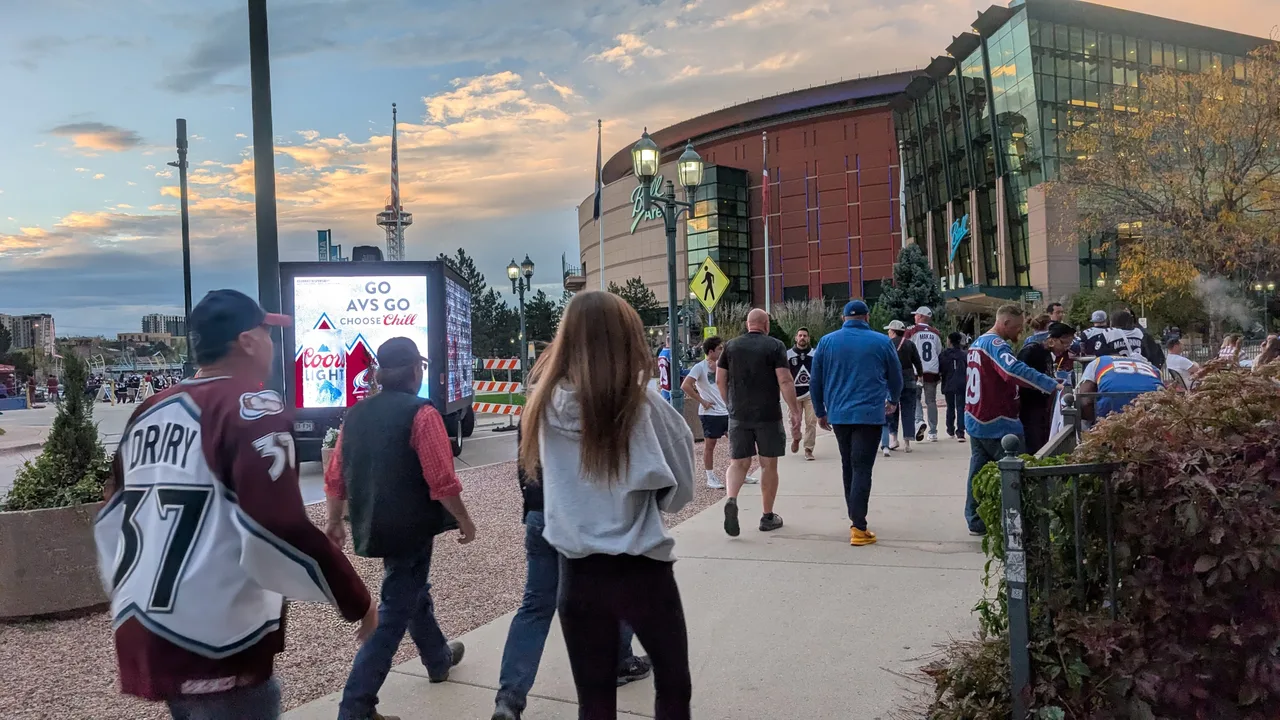
- A printed bulletin beside a highway, a digital screen in a rail station, a wrapped bus, a taxi-top screen, an LED truck parked outside an arena. Three documented ones on this page: a Toccin taxi top in New York (2026), a Coors Light LED truck outside a Denver arena (2025), and a wrapped Amazon fleet at the Las Vegas Convention Center (2026). The archive holds thousands more.
- Is out-of-home advertising still relevant?
- Spending says advertisers think so. OAAA reported US OOH revenue of $9.46 billion in 2025, up 3.6%, the nineteenth consecutive quarter of growth. Whether it is relevant to a given brief depends on placement, creative legibility and whether the audience number was built for the format being bought.
- What are the main types of out-of-home advertising?
- The trade association splits it four ways: billboards, transit, street furniture and place-based. That list works for fixed sites and hides everything mobile. A more useful split separates the ad surface, the thing carrying it, and how the carriers are deployed, because a screen on a moving vehicle behaves unlike a screen on a wall.
- How are out-of-home audiences counted?
- Fixed panels are measured by estimating how many people pass the site (circulation) and what share of them would plausibly notice the ad (a visibility adjustment). Geopath publishes both definitions. Moving inventory inverts the first step: the unit travels through many locations, so delivery depends on route, dwell time and time of day rather than one traffic count.
- Which OOH segment is growing fastest?
- Transit, for the second consecutive year according to OAAA. The 2025 figure is +9.8% in the association's Facts and Figures deck and 9.2% in its March 17, 2026 press release; the 9.8% figure is the one that reconciles with the published $9.46 billion total. Digital formats grew 10.5% and reached 36.3% of revenue.
- Do I buy out-of-home from an agency or directly from a media owner?
- Either, and the answer changes what you control. Media owners sell their own inventory. Specialists operate a single format across markets. Demand-side platforms aggregate many owners programmatically. Agencies plan across all of them. Each layer adds reach and removes direct control.
- How far in advance should an OOH campaign be planned?
- Printed formats need production and installation time, so they are committed weeks ahead. Digital inventory can be booked and swapped much closer to the flight, which is the practical reason planners keep some budget in DOOH even on campaigns built around printed sites. Moving formats add a third clock: the regulator for each city on the route.
- Does out-of-home work with a QR code?
- On a parked unit, sometimes. On a moving one, rarely. If the audience is in traffic or on a crossing, nobody scans anything. Treat a QR code on fast-moving inventory as decoration, and measure the campaign on delivery and brand effect instead.
Sources
- Out of Home Advertising Revenue Reaches Record $9.46 Billion · Out of Home Advertising Association of America (OAAA), March 17, 2026 (corrected March 26, 2026)
- 2025 OOH Ad Spend Performance: Facts and Figures (slide 4: category growth, transit +9.8%) · Out of Home Advertising Association of America (OAAA), April 2026
- Glossary: circulation, daily effective circulation, impressions, visibility adjustment index · Geopath, Accessed September 14, 2026
- Geopath Research Methodology: Measuring Out of Home Audiences · Geopath, Accessed September 14, 2026
- OOH industry advances effort to modernize audience measurement and selects Ipsos for pilot program · Geopath, March 31, 2026
- On-Car Products: digital tops, static tops, car wraps (360°, 270°, 180°) · Firefly, Accessed September 14, 2026
About the author
Ercan Bozkurt writes the methodology pages on this site: how out-of-home inventory is counted, measured and bought, with a particular interest in screens that move. He works from the primary document in each case, the transit authority's own rulebook, the measurement body's own definitions, the company's own filing, and writes the page so that a media planner can check every figure against it.
Ercan Bozkurt on LinkedIn · Reviewed by Melih Koray, who publishes this site · How this site is edited and what it refuses to publish: about this site.