Digital billboard advertising: what changes when the bulletin is a screen
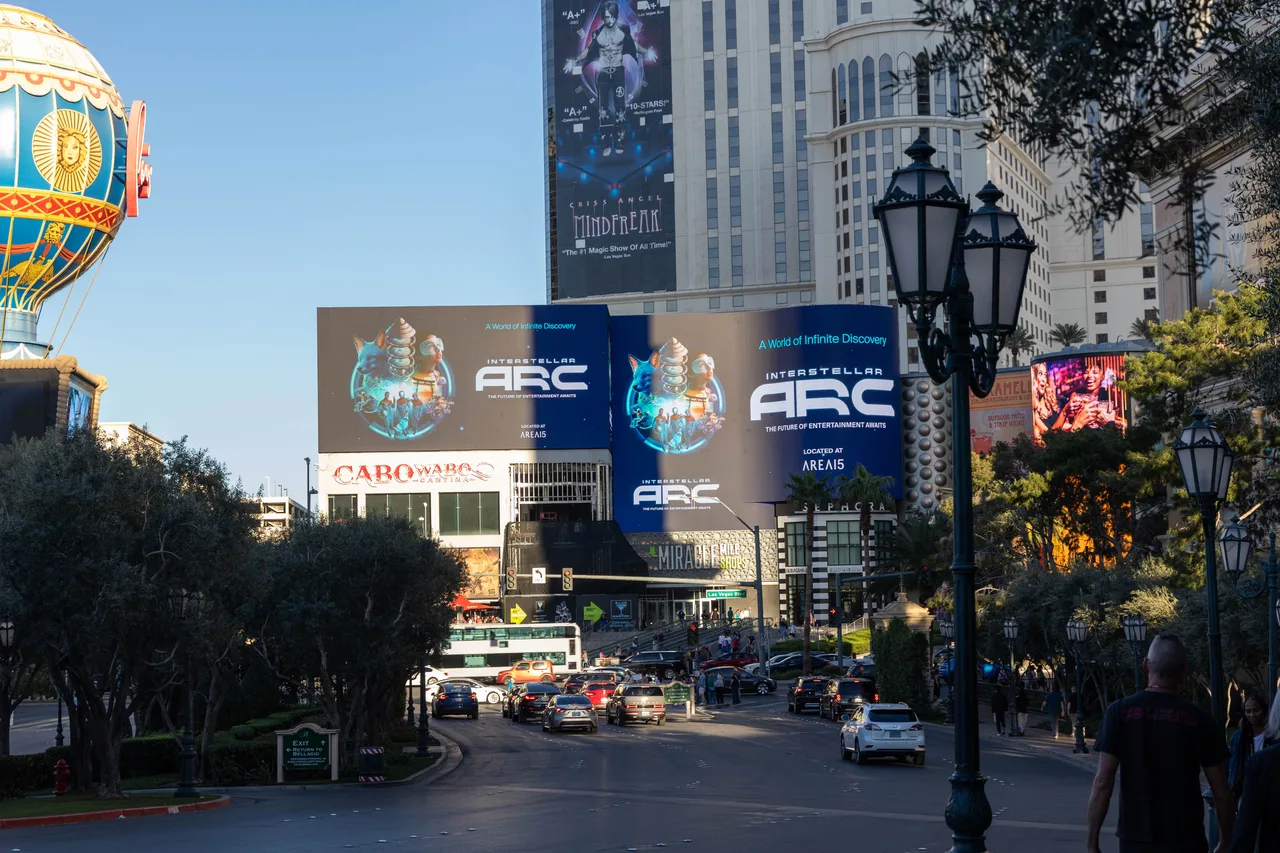
Digital billboard advertising sells time on a screen rather than a face on a structure: a spot of about eight seconds in a loop shared with other advertisers, changeable within minutes with no print cost. The trade-off is share of time, one-eighth of the cycle on the one published loop, under dwell rules each state sets within federal guidance.
A digital billboard is a bulletin that has become a schedule. The structure, the road and the audience are the same as for the vinyl face beside it; what is sold is different. The Out of Home Advertising Association of America counted 25,000 digital billboards in the United States at the end of 2025 against 210,000 static bulletins and 160,000 posters, and digital of all kinds took 36.3% of a $9.46 billion category. This page covers only the digital-specific part of the decision: the loop, the published specs, what third parties publish on price, how a spot is measured against a unit, and who sets the dwell rule. The wider choice of format, fixed or moving, is on the guide to out-of-home advertising.
What changes when the bulletin is a screen?
Everything about timing and nothing about location. A static face is yours for the flight; a digital face is a rota, and your purchase is a position in it. The table uses only what operators and publishers have put in writing.
| Static bulletin | Digital bulletin | |
|---|---|---|
| What you buy | A face on a structure, yours for the flight | A spot in a loop, shared with other advertisers on the same screen |
| Share of time | 100% of the face | Spot length divided by loop length: 8 seconds in a 64-second loop is one-eighth |
| Production | Vinyl printed and installed per face; a creative change is a new print and a new posting | A file uploaded to the operator; Lamar and Clear Channel Outdoor both publish "no production cost" for the media itself |
| Time to change | Blue Line Media asks for static creative 2 to 3 weeks before start | Lamar: "display your ad within minutes"; Blue Line Media asks for digital creative 3 business days before start |
| Dayparting | None; the face is up all day | Creative scheduled by hour and day |
| Dynamic creative | None | Lamar lists weather, countdowns, drive times, live scores, flight data and lottery feeds as triggers |
| Motion | None | Still none on roadside units: FHWA guidance and state rules require static images that change, not video |
| Measurement | Impressions for the unit | Impressions for the unit, allocated to plays; your spot receives its share |
| Operator economics | One advertiser per face | OUTFRONT Media reports digital billboards generate about four to five times the revenue per display of comparable static ones, at two to four times the cost |
The last row explains the first. OUTFRONT Media's 2025 annual report states that digital billboard displays "generate approximately four to five times more revenue per display on average than comparable traditional static billboard displays", at "approximately two to four times more costs". One structure is sold to several advertisers at once; that is the loop, and it is why the same location costs less per advertiser and delivers a fraction of the time. Lamar, with over 5,600 digital displays, and Clear Channel Outdoor, with 4,000, both publish "no production cost" as the advertiser's side of the trade.
How does a digital billboard loop work?
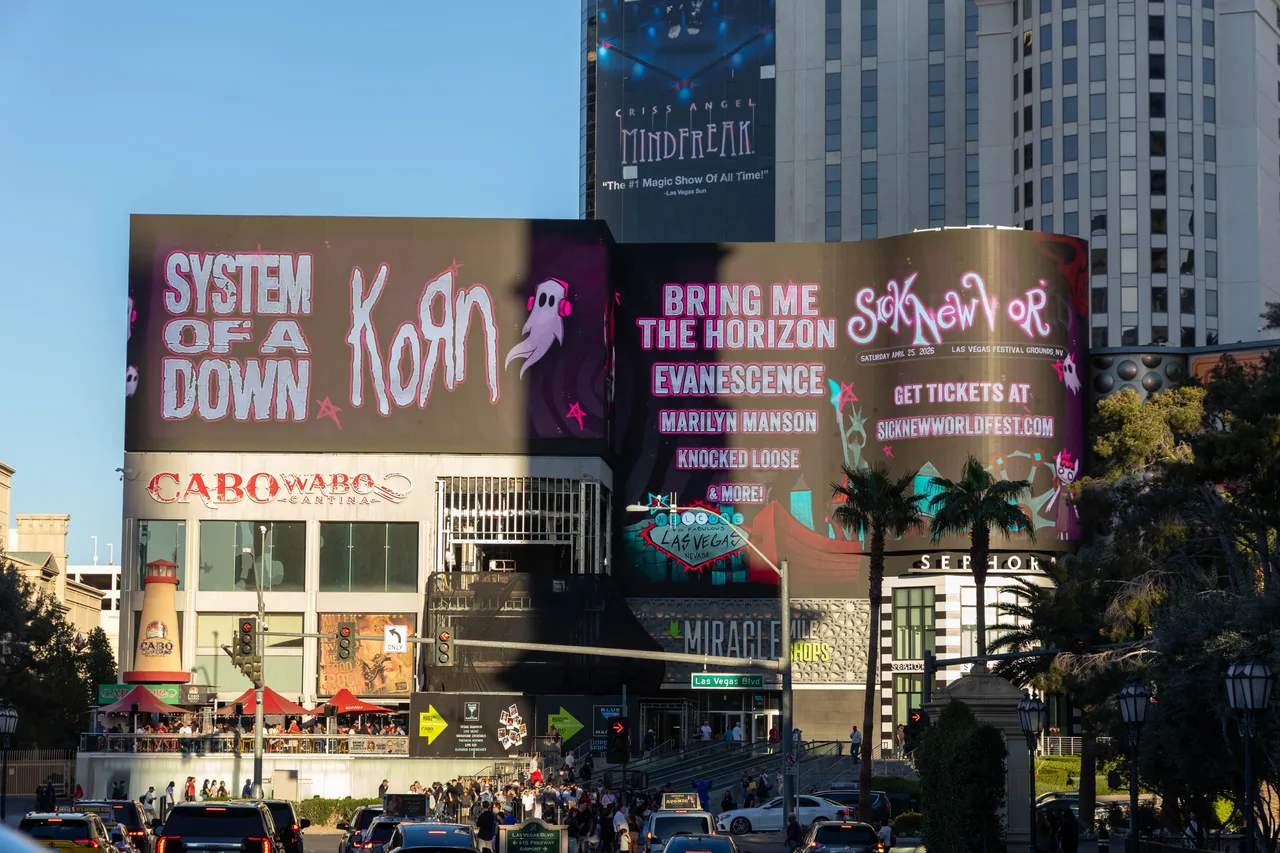
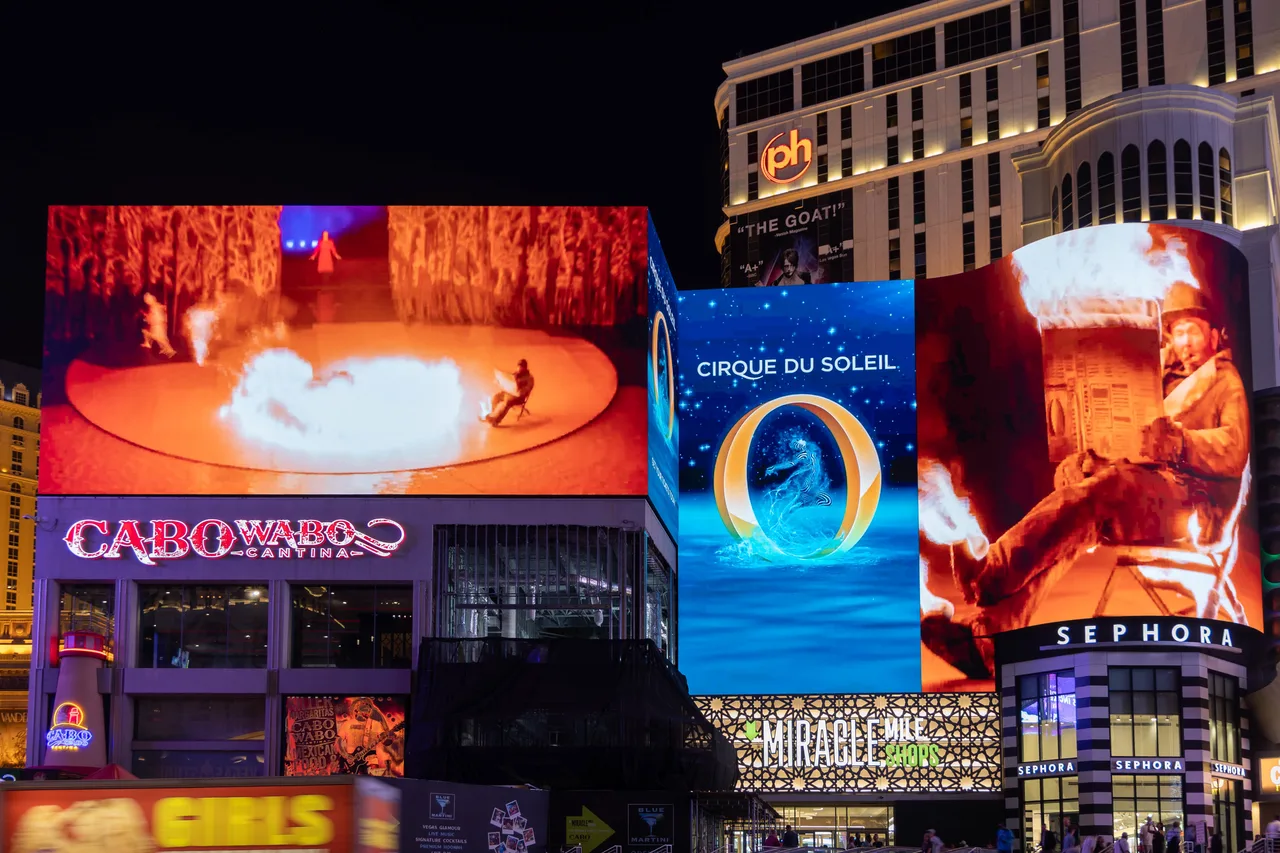
Your share of the audience is your spot length divided by the loop length. Lamar's digital products page says ads "rotate in a slide show fashion every 6 to 8 seconds"; its programmatic formats page says "every 6-10 seconds depending on location". The Federal Highway Administration's 2007 guidance puts acceptable dwell at 4 to 10 seconds with 8 recommended, which is why 8 seconds is the number most operators build around. The clearest published loop is not a bulletin at all: OUTFRONT Media's specification for the MTA Digital Urban Panel is an 8-second spot in a 64-second loop, one-eighth of every cycle, static creative only.
Three numbers decide what you are buying: spot length, loop length, and how many advertisers the operator sells into the loop. Eight 8-second spots in a 64-second loop give each advertiser 12.5% of the screen's time; six spots in 48 seconds give 16.7%. Some operators sell a higher share of voice, two or more positions in the same loop, at a proportionally higher price. Ask for all three numbers in writing; a proposal that says only "8-second spots" has told you the numerator.
What are the digital billboard ad specs?
Pixels in RGB rather than inches in CMYK, a still image rather than a print, and a dwell time rather than a posting date. Lamar Graphics publishes its templates in full and they are the most complete public spec; the federal and state rows come from the guidance and statutes in the regulation section.
| Item | Published specification |
|---|---|
| Bulletin template (Lamar "Auto Scale Bulletin") | 400 px high × 1400 px wide; fits most 14' × 48', 10' × 36', 12' × 40' and similar faces |
| Poster template (Lamar "Auto Scale Poster") | 400 × 840 px; fits most 10' × 21', 12' × 24', 14' × 28' |
| Colour | RGB, sRGB profile; black is R0 G0 B0; convert PMS to RGB |
| File | JPG, BMP or GIF at maximum quality; "NO ANIMATED GIFs" |
| Spot length | Lamar: ads rotate "every 6 to 8 seconds" on its digital products page and "every 6-10 seconds depending on location" on its programmatic formats page; FHWA guidance: 4 to 10 seconds, 8 recommended |
| Motion | None on roadside: FHWA lists "animation, flashing, scrolling, intermittent or full-motion video" as unacceptable |
| Creative deadline | Blue Line Media: 3 business days before the start date for digital, 2 to 3 weeks for print |
Two consequences for creative. The image is scaled to faces of different size and resolution, so the operator's "auto scale" template matters more than any one board's pixel count. And because the spot is a still, the eight seconds are the whole ad: no build, no reveal, no sequence across two spots, and no sound anywhere in the category.
Can you buy digital billboards programmatically?
Yes, and increasingly that is how the loop is filled. Clear Channel Outdoor's digital page describes transacting "via private marketplace or open exchange in a biddable, auction-based format via cross-channel DSP"; Lamar publishes a programmatic formats page; Blip sells single plays through a self-serve interface with a daily budget. The OAAA's 2025 Facts and Figures deck, citing MAGNA and Rapport, puts programmatic at 30% of US digital out-of-home sales in 2025, up from 15% in 2023 and 24% in 2024, and projects 65% by 2029. How the supply chain fits together, and what a deal ID actually buys, is on programmatic DOOH.
For a digital bulletin specifically, programmatic drops the unit of purchase from a four-week share of loop to individual plays, priced per thousand impressions and scheduled by hour and audience. It does not change the loop, the dwell rule, or the fact that a play on a shared screen is one spot among several.
How much does digital billboard advertising cost?
The ranges below are market-level figures compiled from publicly published vendor and industry sources. They are not quotes, and they are not the rates of any single network, including the operator whose campaigns the archive on this site documents, which prices per campaign and does not publish a rate card. Always get a written quote before budgeting.
No billboard operator publishes a digital rate. Lamar's and Clear Channel Outdoor's digital pages end in a contact form, and OUTFRONT Media's annual report discusses digital in revenue multiples, not prices. The published figures come from a reseller, an editorial site and a self-serve platform, and they price three different things.
| Publisher | Retrieved | Published figures |
|---|---|---|
| Blue Line Media, billboard rate card | Read September 14, 2026 | Digital bulletin (large) $3,500 to $25,000 per display per 4 weeks; digital poster (medium) $2,000 to $5,000; static bulletin on the same table $1,500 to $30,000. Minimum purchase $5,000 or higher per market. "Range of rates depends on timing, duration and market." |
| business.com, "What does a billboard cost?" | Updated January 27, 2026; read September 14, 2026 | Digital per month: major metro $5,000 to $20,000 (shared rotation), with premium full-time or marquee zones "can exceed $10,000/day"; large metro $2,000 to $10,000; midsize city $1,500 to $6,000; small city or suburban $1,200 to $4,000; rural $770 to $2,000. Estimates credited to Times Square Billboard, Plug Talk, Indeed and Broadsign. |
| Blip, self-serve platform | Read September 14, 2026 | Pay per play: an 8-second "blip" priced "as low as $0.01 per display", daily budgets "as low as $20 in some locations", no minimum spend and no contract. Network stated as "over 2,700 digital billboards across 46 states" on the home page and "3,500+" on the pricing page, the same day. |
The digital-specific delta, read off those rows. On Blue Line Media's own table the digital bulletin floor is $3,500 against $1,500 for static, 2.3 times higher, while the digital ceiling of $25,000 sits below the static ceiling of $30,000: the cheapest digital position costs more than the cheapest static face, the most expensive costs less, and the digital figure buys a share of the loop where the static one buys the whole face. Against that, a static creative change is a new print and posting each time; a digital one is a file. business.com prices per calendar month where Blue Line prices per four weeks, an 8.5% difference before any other variable. Blip removes the cycle altogether and prices the play, the only model here where what you pay maps onto the unit Geopath measures. None of the three states a method, and a marketplace whose cost page was read for this site's August 2026 rate reconciliation blocked retrieval on September 14, 2026 and is not cited.
How are digital billboard impressions measured?
For the unit first, then for the play. Geopath, the industry's audience measurement body, defines impressions as "the total number of times people passing an OOH display are likely to notice the ad", a gross count that includes duplicated views and is not a count of people. Circulation, the opportunity to see, is explicitly "no longer a credible measure of an Out of Home audience"; the visibility adjustment converts one into the other. That arithmetic is the same for a screen and a vinyl face, and is worked through on how out-of-home impressions are measured.
The digital step is allocation. Geopath's measurement note says that reporting by season and daypart will "allow us to breakdown impressions to an ad play during an hour", and its 2019 standards document notes that dwell time governs "the number of spots that a single person has an opportunity to see". A unit's hourly impressions belong to the loop; a spot receives its share. The question to put to any digital proposal is whether the impression figure is unit-level, everything the screen delivers, or spot-level, your one-eighth of it. Both are legitimate. They differ by the size of the loop.
All of it is on the outgoing method: Geopath and the OAAA selected Ipsos in March 2026 to pilot a next-generation system from the second half of 2026, with transition from 2027 and adoption anticipated in 2028.
Who regulates digital billboards?
Three layers, and the state writes the number. The Highway Beautification Act of 1965 requires each state to maintain effective control of outdoor advertising along the Interstate and federal-aid primary systems; 23 U.S.C. 131(b) cuts a non-complying state's federal-aid highway funds by "10 per centum", and 131(d) leaves size, lighting and spacing to agreements between the Secretary and each state. The Federal Highway Administration's memorandum of September 25, 2007 told its division offices that changeable electronic signs may be permitted where the Federal/State Agreement allows, within a range it regarded as acceptable: message duration of 4 to 10 seconds with 8 recommended, transitions of 1 to 4 seconds with 1 to 2 recommended, brightness adjusted to ambient light, spacing consistent with existing sign rules, and no "animation, flashing, scrolling, intermittent or full-motion video".
| Format | Who regulates it | What the rule covers |
|---|---|---|
| Roadside digital bulletin or poster on an Interstate or federal-aid primary route | State DOT under its Federal/State Agreement, within 23 U.S.C. 131 and FHWA guidance | Dwell time, transition, brightness and spacing set by state statute or rule; a state that fails effective control loses 10% of its federal-aid highway funds |
| Roadside digital sign off the federal-aid system | County or city zoning and sign code | Local ordinance; often stricter than the state, sometimes a ban |
| Digital bus shelter or street furniture screen | City street-furniture franchise | Franchise agreement and city policy; the transit authority is usually not the owner |
| Digital urban panel at a transit entrance | Transit authority advertising policy and concession | Loop position and content standards; the MTA panel runs an 8-second spot in a 64-second loop, static only, no audio |
| Digital screen on a vehicle | Vehicle or taxi regulator plus local ordinance | Licensing of the unit and the vehicle rather than dwell rules; covered format by format on transit advertising |
Within that federal range each state picks its own numbers, and they are not the same. Four read from the statute or rule itself, or from the OAAA's compendium where the state site could not be read:
| State | Published rule | Citation |
|---|---|---|
| Ohio | Each message "shall remain fixed for at least eight seconds"; a change "shall be accomplished in three seconds or less"; no animation, video, flashing, fading or intermittent light | Ohio Admin. Code 5501:2-2-02, effective April 30, 2023 |
| Minnesota | Message may not change more often than once every six seconds; transition no more than two seconds; brightness no more than 0.3 foot-candles over ambient; automatic dimming required | Minn. Stat. 173.155 (2017) |
| California | No message change that "exposes its message for less than four seconds"; no message center display within 1,000 feet of another on the same side of the highway; nothing in motion or appearing to be in motion | Cal. Bus. & Prof. Code 5405(d)(1), amended 2000 |
| Georgia | Each multiple message sign "shall remain fixed for at least ten seconds"; mechanical change in three seconds or less; electronic transitions within two seconds; 5,000-foot spacing | Ga. Code 32-6-75(c)(1), as reproduced in the OAAA compendium of state laws (2019) |
Four seconds in California, six in Minnesota, eight in Ohio, ten in Georgia, all lawful under the same federal memo. The OAAA's 2019 compendium counted 45 states allowing changeable message signs and one, Washington, that did not; that document is seven years old and the count should be checked before it is repeated. Below the state sits the city or county sign code, which can be stricter or a ban. Screens on transit property and on vehicles answer to different regulators again: a digital shelter is a city franchise rather than a transit asset, as the bus advertising page shows, and the national table of who regulates each moving format is on transit advertising.
How do you reach the same audience at street level?
A digital bulletin sells a share of one loop at one coordinate. The same screen logic, dayparted creative and a message keyed to weather or a score, exists on inventory that moves through the district instead of watching one road: Firefly sells digital tops on taxis and rideshare vehicles with weather-triggered, data-triggered and location-based creative, in 15 named markets, alongside static tops and wraps; Blue Line Media resells digital rideshare tops city by city; Can't Miss US runs LED trucks nationally. The trade is the audience number: a bulletin has a Geopath figure and a moving screen has a route log, and the two are not the same unit, as how out-of-home impressions are measured sets out.
When is digital the right choice?
When the message changes, when the hour matters, or when the lead time is short: a weekend offer, a same-night programme, six creatives in rotation, a message keyed to weather or a score. Each buys exactly what the loop sells and pays nothing to change the print. When the message does not change and the objective is presence, a static face gives the whole unit, the whole day, for one print cost. The two are combined more often than chosen between. Neither follows the audience; for inventory whose location changes during the campaign the trade-offs are different, and they are the subject of the rest of this site.
Frequently asked questions
- How much does a digital billboard cost to advertise?
- No billboard operator publishes a digital rate; the three largest, Lamar, OUTFRONT Media and Clear Channel Outdoor, quote per unit on request. Third parties do publish: Blue Line Media lists a digital bulletin at $3,500 to $25,000 per display per four weeks; business.com lists $5,000 to $20,000 per month for a shared rotation in a major metro and $770 to $2,000 in a rural market; Blip sells single 8-second plays from a cent against a daily budget. All three were read on September 14, 2026, none states a method, and the units differ.
- Is a digital billboard better than a static one?
- It is a different purchase. Digital gives you dayparting, creative changes within minutes with no print cost, and data-triggered messages; in exchange you hold one position in the loop, one-eighth of the cycle on the published MTA panel spec, rather than the whole face. Static gives you 100% of the face and the unit's full impressions for the flight, at the price of a print and a posting every time the message changes. Long single-message campaigns lean static; short, timed or rotating campaigns lean digital.
- How does a digital billboard rotation work?
- The screen plays a loop of spots. Your share of the audience is your spot length divided by the loop length: an 8-second spot in a 64-second loop is one-eighth of every cycle. Lamar states its ads rotate every 6 to 8 seconds; FHWA guidance puts acceptable dwell at 4 to 10 seconds. Ask the operator for spot length, loop length and the number of advertisers in the loop, and whether a higher share of voice is sold.
- Can digital billboards show video?
- Not on roadside units in the United States. The Federal Highway Administration's 2007 guidance treats animation, flashing, scrolling, intermittent and full-motion video as outside the acceptable range, and state rules follow it: Ohio and Minnesota prohibit animation and video outright, California prohibits anything in motion or appearing to be in motion. Full motion exists on place-based and transit screens that sit outside highway control, such as the MTA's Video Urban Panel, which runs 15-second full-motion spots with no audio.
- What are digital billboard ad specs?
- Pixel dimensions in RGB rather than inches in CMYK. Lamar's bulletin template is 400 pixels high by 1,400 wide and fits most 14 by 48 foot faces; its poster template is 400 by 840. Files are JPG, BMP or GIF at maximum quality, sRGB, no animated GIFs. The spot is a still image that holds for the operator's dwell time, then changes. Build to the operator's template for the specific unit; ratios differ between faces.
- Is owning a digital billboard profitable?
- The one public operator that puts numbers on it says yes, for a portfolio. OUTFRONT Media's 10-K for 2025 states that digital billboard displays generate approximately four to five times more revenue per display than comparable static ones at two to four times the cost, so they "generate higher profits and cash flows". Whether that holds for a single sign depends on the site, the permit and whether the loop sells out.
- How are digital billboard impressions measured?
- Geopath measures impressions for the unit, then allocates them to plays: its 2021 measurement note says digital impressions can be broken down "to an ad play during an hour", and its 2019 standards note that dwell time changes how many spots one passer-by can see. So a digital unit's impressions belong to the loop, and an advertiser holding one spot in eight receives roughly one-eighth of the unit's hourly figure. Ask whether a proposal quotes unit-level or spot-level impressions.
- How do I get on a digital billboard?
- Three routes. Direct from the operator that owns the sign, on a four-week cycle with a share of the loop. Through a programmatic platform, buying plays by audience, hour and budget. Or through a self-serve marketplace such as Blip, which sells individual plays against a daily budget with no minimum. The creative rules are the same on all three.
Sources
- Digital advertising products: 5,600+ displays, ads rotate every 6 to 8 seconds, no production cost · Lamar Advertising Company, Accessed September 14, 2026
- Programmatic DOOH media formats: digital ads rotate every 6-10 seconds depending on location · Lamar Advertising Company, Accessed September 14, 2026
- Digital capabilities: weather, countdown, drive time, live score, flight and lottery data triggers · Lamar Advertising Company, Accessed September 14, 2026
- Lamar Graphics digital display templates: Auto Scale Bulletin 400 × 1400 px, Auto Scale Poster 400 × 840 px, RGB, no animated GIFs · Lamar Graphics, Accessed September 14, 2026
- Digital billboards: 4,000 digital displays, no media production costs, conditional triggers, programmatic via PMP or open exchange · Clear Channel Outdoor, Accessed September 14, 2026
- Form 10-K, fiscal year 2025: digital billboard revenue and cost multiples versus static; 103 digital billboard displays built or converted in 2025 · OUTFRONT Media Inc., via U.S. Securities and Exchange Commission, Filed February 26, 2026
- NYC MTA Digital Urban Panel specification sheet: 8-second spot, 64-second loop, static only, no audio · OUTFRONT Media, Accessed September 14, 2026
- 2025 OOH Facts & Figures: OOH displays nationwide at year end 2025; programmatic share of DOOH 2019 to 2029 · Out of Home Advertising Association of America (OAAA), April 2026
- Out of home advertising revenue reaches record $9.46 billion; DOOH 36.3% of revenue, up 10.5% · Out of Home Advertising Association of America (OAAA), March 17, 2026
- Guidance on Off-Premise Changeable Message Signs: memorandum to Division Administrators · Federal Highway Administration, September 25, 2007
- Outdoor Advertising Control: the Highway Beautification Act of 1965 · Federal Highway Administration, Accessed September 14, 2026
- 23 U.S. Code 131, Control of outdoor advertising: 10 per centum penalty; size, lighting and spacing by agreement · Legal Information Institute, Cornell Law School, Accessed September 14, 2026
- Ohio Admin. Code 5501:2-2-02, general provisions for the erection and control of advertising devices · Legal Information Institute, Cornell Law School, Effective April 30, 2023; accessed September 14, 2026
- Minnesota Statutes 173.155, Changeable electronic variable message signs · Office of the Revisor of Statutes, State of Minnesota, Enacted 2017; accessed September 14, 2026
- California Business and Professions Code section 5405(d), message center displays · California Legislative Information, Amended by Stats. 2000, ch. 787; accessed September 14, 2026
- Changeable Message / Digital Technology Compendium of State Laws · Out of Home Advertising Association of America (OAAA), 2019
- Glossary: impressions, circulation, visibility adjustment index, unit · Geopath, Accessed September 14, 2026
- Measurement Foundations: What is an Impression? (digital inventory broken down to an ad play during an hour) · Geopath, August 6, 2021
- Geopath Insights Best Practices, Standards, and Protocols: dwell time and the number of spots a person can see · Geopath, November 2019
- OOH industry advances effort to modernize audience measurement and selects Ipsos for pilot program · Geopath, March 31, 2026
- Billboard advertising rates: static and digital bulletin, poster, creative deadlines, minimum purchase · Blue Line Media, Accessed September 14, 2026
- What does a billboard cost? Digital tiers by market · business.com, Updated January 27, 2026; accessed September 14, 2026
- Blip pricing: pay per 8-second play, daily budgets, no minimum · Blip, Accessed September 14, 2026
- Blip home page: over 2,700 digital billboards across 46 states · Blip, Accessed September 14, 2026
- On-Car Products: digital tops, static tops, car wraps (360°, 270°, 180°) · Firefly, Accessed September 14, 2026
About the author
Melih Koray is a marketing and SEO practitioner who documents out-of-home media, with a particular interest in inventory that moves. On this site he writes the vendor and ranking pages, where the question is who owns what and what each seller publishes, and he edits every page, tracing each statistic to a named and dated source.
Melih Koray on LinkedIn · How this site is edited and what it refuses to publish: about this site.